Before you start
Nothing here needs an account, a launcher or a network. On a Mac or a PC it
is one line in a terminal; from source it is one cargo command. The
installation lines are on the front page and in the repository's README.
Gamepad is the intended input, and a keyboard works. The design rule is that you map intentions rather than lines, and that each control's nature matches the gear it stands for: the helm and the mainsheet are positions your hand holds, the genoa sheet is a winch you grind, and a reef is a job you do.
The cockpit camera heels with the boat. That is deliberate. Heel is the primary feedback channel on a sailing boat, and a view that stays level throws it away.
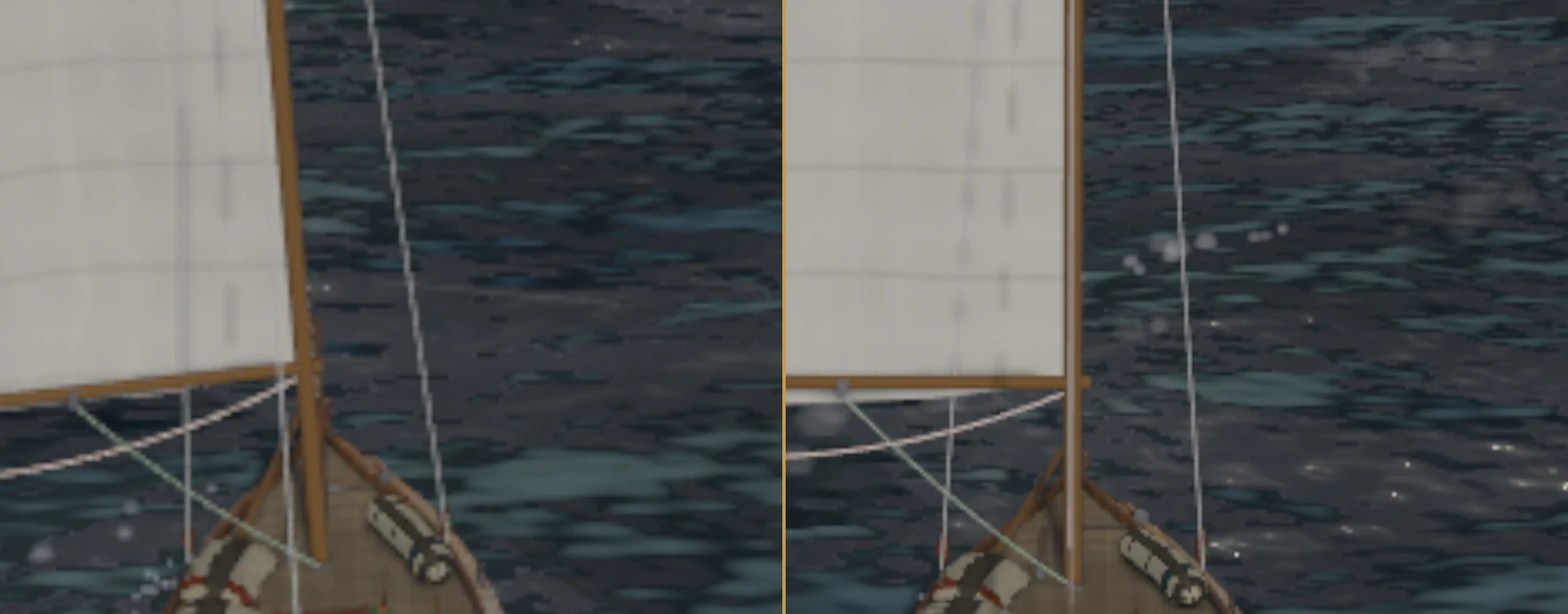
The picture has a grain, and you can choose how coarse it is.
Esc, then PICTURE: the row marked pixels offers 720,
960, and sharp. The world is drawn at that many pixels across and put on your
screen at whatever size your screen is, with no filtering in between — so the
sea's glitter is a dance of individual lit pixels rather than a sheen, and the
rigging is a stepped line. None of it is a filter over a modern image; it is a
genuinely small image, which is why it does not look like one with an effect on
it.
720 is what the game does unless you tell it otherwise, and it is where everybody who has sat down with this has ended up. 960 is the same picture finer, and it is worth knowing about if you are on a large display, where the coarse one stops reading as a drawn picture and starts reading as a low-resolution one. sharp turns the grain off entirely, for when you want to see what is actually on the deck.
The console and the chart stay crisp at every setting. They are drawn afterwards, in screen space: a pixelated instrument is a nostalgic idea rather than a readable one.
The boat
A production charter sloop of about 34 feet: 9.20 m on the waterline, 5,500 kg displacement, 64 m² of sail, hull speed 7.36 knots. She carries a mainsail with three slab reefs and a wardrobe of headsails — genoa, code 0, gennaker, spinnaker — one of which is set at a time.
She is not fast and she is not meant to be. Best upwind VMG in twelve knots of true wind lands at 40 degrees off the wind: 5.6 knots through the water, 4.1 of velocity made good, 21 degrees of heel, 3.6 degrees of leeway. Those are the numbers off a real boat, and the polar on the front page is generated rather than drawn.
Your first passage
The mission is the oldest job on the coast: you are a delivery skipper, and somebody's boat has to be somewhere by a certain time. The panel in the top left says where you are bound, how far it is, what the bearing is and how long you have.
- Look at the glass before you look at anything else. OUTLOOK on the console tells you what the barometer is doing, which is what decides whether you are about to be overpowered. Rising and steady is a pleasant afternoon; falling and backing is a reef you should put in now rather than in twenty minutes.
- Set a headsail and sheet the main.
XandZwalk the wardrobe — and what they do is order a sail rather than switch one on. The foredeck rolls the old one away, bends the new one on and sets it, which is a job with stages and takes the time it takes.WandSare the mainsheet;QandEare the genoa winch. - Steer with the tiller and watch the telltales. The tiller holds the angle
you leave it at — it is not a spring.
Spacecentres it. - Hand the sails to somebody else when you want to navigate.
Shift Tcalls the watch on deck: they trim the sheets continuously to the wind each sail actually meets, work the shape controls one line at a time, and choose the right sail for the angle and the breeze. A hand on any sheet stands them down, the way a hand on the tiller takes the helm from the pilot. - Put the pilot on for a long leg.
Pengages it andOchooses which of the two it is — a tiller pilot holding a compass course, or a vane holding an angle to the wind. - Fix your position before you need it. Not when you are closing the land in failing light. Three bearings, crossed, entered in the log.
The instruments
The case is one glass in the corner, in every view. The top half is the compass card as you see it looking down into the bowl, with a window at the lubber line. The bottom half is the sea, cut as a segment of the same glass, so that however far she lies over, the water stays inside the bowl. The boss in the middle is the wind she is actually in: apparent on the needle, true behind it.
The bezel is the part that is navigation. On it: where the wind is from, the shaded water she cannot sail into, and the two headings that bound it — which is what a beat consists of. Can I lay it on this tack is read straight off the ring instead of being worked out from three numbers, and the angle comes from her own polar rather than from a book, so it narrows when she is reefed and opens when she is footing.
Nothing is printed beside the drawing of itself. Her head is the card, the apparent wind is the needle, her heel is the line across the bottom of the bowl — so those three figures are not also set in type next to them, which is the oldest way to make an instrument panel unreadable. What is printed is everything the glass cannot show: the log, the strength of both winds, what she is making good, the water under her, and what the barometer is doing.
Each view gets the tools its job needs. At the helm you are working the sheets, the preventer and the pilot, so the rack of seven control lines is pinned in the middle. From astern you are watching her sail and thinking about what is set. Under the water you are fishing, and there is nothing on this boat you could adjust from down there.
When it blows
Ease before you reef. That is the order that matters: a slab is twenty
minutes of work and a sheet is a second. The dump — R — eases until the
deck is steady and the pilot can hold her; pressed again, or held, it lets
everything go, and she stops with the cloth flogging.
Then reef, in stages. Three slabs and then she is handed: full, one, two,
three, down. Each slab takes a sixth of her off, and the step from the second reef to
no mainsail at all is the one you need in the forties. The reef and the furling line
are lines in the clutch bank — 1 and 2 pick one,
A and D work it.
Rig the preventer for a long run and take it off before you gybe.
F. The whole point of it is that it stops the boom coming across, which
is also exactly what makes it dangerous if you forget it is there.
It arrives on the console before it arrives on the boat: bearing, distance, and whether it is passing or coming for you. A squall that has been announced and ignored is the commonest way to be knocked down in this game, because the wind in it both builds and veers.
If somebody goes in
There is a horseshoe lashed to the starboard quarter on a short strop, twenty
metres of floating line coiled on the same cleat, and a canvas grab bag over them.
Enter throws the ring.
The throw is the part that cannot be late. A person in the water makes two per cent of the wind speed and a ring of foam makes four to eight, so the ring walks away downwind at fifteen metres a minute. Thrown early it is something he can swim to; thrown after a minute of getting organised it is upwind of nothing. Those are search-and-rescue numbers rather than invented ones, and the whole drill turns on them.
Then get her back to him and pick him up. The boathook reaches by itself —
you do not aim it — and Enter takes the catch. When is the
whole of it: a hook put on while the deck is dropping away is a hook torn out of
your hands, and the sea decides when that is, not the player.
Esc, then the MISSIONS page, practises the lot on a dan
buoy — and it is also the best way into the game, because it teaches you to sail
her on the way.
The pattern it coaches is the figure of eight: bear away onto a beam reach and sail four boat lengths, tack, work down to leeward of him, then come up at him on a close reach with everything eased, and arrive stopped. That is what the RYA and US Sailing both teach for a yacht with the casualty in sight, and it works under sail because it never asks her to gybe and ends on a close reach — the only point of sail you can stop a boat on. The Williamson turn out of the IAMSAR manual is the right answer for a ship under power and the wrong one here.
Each leg comes with a target heading, an arrow, and a mark put in the water at the point she should be steering for. That hand-holding is deliberate: a beginner told to work down to leeward of him has no idea what that means, and a beginner steering at a lit mark learns what it means by doing it. The coaching inside each leg is advice rather than a gate — the drill ends when Oscar is aboard, however you managed it.
Taking a ship in
The oldest job on this coast, and the one that pays. A square-rigged brig comes in from the open sea wanting somebody who knows the water, and you are the boat that knows it.
Pilotage is leading, not boarding. Nobody steps across — you take the flag, you catch her up, and you get out in front of her. From there she follows your water, which means every rock you clear she clears and every one you cut fine she cuts finer, in a hull that draws more than yours and cannot turn like yours.
The flag H — I have a pilot aboard — goes up in your own rigging the moment you take the job, and stays there until the work is done. The chart draws the water you ought to be leading her through.
It ends on the water, not alongside. Bring her to clear water off the
anchorage, and Enter hands her back: the flag comes down and she is
the harbour's problem from there. Which is what a pilot actually does — the berth
is somebody else's job.
The job is on the MISSIONS page under Esc, beside the
overboard drill.
Finding out where you are
One instrument at a time, and you get one hand.
Shift B is a pair of glasses and Shift N a hand
bearing compass; picking one up puts the other down, because seven-by-fifties are
two-handed on a moving boat and a compass is held out at arm's length. Either of
them puts you in the cockpit. Spreading the chart puts both away: you work on the
paper or you work on the horizon.
Name the marks first. B asks whether what is in the glasses is
enough: a mark near enough to read its symbol names itself, and three well spread
apart are a shape that belongs in one place on the coast — worked out the way a
station pointer does it, from the two horizontal angles between them.
Then shoot bearings. N, with the notch held on the mark. It
answers either way: the name and the number if it caught, and how far off you were if
it did not. Holding a notch a degree and a quarter wide on a mark from a moving deck
is the small act of steadiness the instrument exists to need.
The book is where a navigator writes things down — not the chart. Every bearing, every mark made out, every reading off the log goes on the page beside the paper with the time against it. Two buttons, because marking the paper and writing the book are two acts: ON THE CHART puts the position on the paper and is dead until two lines cross; IN THE LOG writes the line and is live always.
Use the rubber. One press takes a doubtful line off the paper and another puts it back where it now belongs, because the usual reason a fix will not close is a line you should not have believed.
WHY, on the end of the row of instruments, makes every line on the paper say what it is and why it is there — position line, transferred, ruled by hand, log leg, reckoning, track made good. A plot is six kinds of line in two colours with no legend, and telling them apart is most of the subject.
The reckoning is a sequence of courses, not a line, and the plot is as old as your last visit to the chart table. She knows she tacked — the compass is on the bulkhead — but the paper goes on laying off the course it was last told, with the miles off the log, and the pencil position walks away from her. Ten minutes of unwritten log after a ninety-degree tack is a mile and a half of pencil error, measured. Spreading the chart writes it up.
The start
The one thing sailing has that nothing else does is the start. You cannot stop a sailing boat and you cannot park her — she is always going somewhere — so the start of a race is not a button but a manoeuvre. You spend the last five minutes making the boat arrive at a line she must not touch early, at full speed, at the end of it you have decided is favoured. Everybody who has raced knows the race is usually decided there, and everybody who has not is astonished by it.
The favoured end is calculated, not invented. A line a hundred and forty metres long that is ten degrees off square to the wind hands you twenty-odd metres of free distance at one end of it, and the panel says which end and by how many metres — metres being the only unit you can think in on the water. Over early and you come back, which is the one rule that makes a start a start.
Four legs, windward and leeward, about twenty minutes. The course is laid off the wind at the moment it is set: one buoy dead upwind, another dead downwind, so every leg is a beat or a run and nothing in between. That is deliberate — those are the two points of sail with something to decide on them. A reach is a lovely thing to sail and there is nothing to do on it but steer, and a course made of reaches is a course where the boat that started first wins.
The marks are rounded by being near them — twenty-five metres — because which side you passed is a question this game cannot answer honestly, and a rule it cannot enforce is better left to the sailor.
No other boats. The fleet exists and the times that would make it a race are two fields on the wire, but there is nobody to start against, and so no rules of the road either — boats here do not collide, and a protest nobody can lodge is a rule nobody has. What is here is the clock, the line, the marks, and being sent back when you are over early.
The rod
She was an open fishing boat until 1964, so there is a rod in a holder on her port quarter. It is not a minigame beside the sailing; it is bolted to it, and the join is one fact: a fish on the line at six knots is a fish you are going to lose. The water dragging a nine-kilo ling broadside at that speed pulls harder than the line will stand, so the first thing you do when something takes is get the way off her — and the gear for that is the mainsheet, the dump, the backed headsail and the helm you already have. The rod has no speed control. The boat is the speed control.
Depth is the boat's speed. At five knots a trolled lure skips along in the first metre or two; take the way off her and it sinks hard — nine metres at two knots and thirty at one. That is why mackerel are caught fast and shallow and cod are caught slow and deep: the boat chooses the quarry before the tackle does. The splash astern is the depth gauge, and it is gone by four metres.
The drag is the whole game, and it is wrong in both directions. Too tight and the hook comes out of the fish's mouth, because load is what opens the hole it sits in. Too light and the fish never tires at all — fatigue is charged for work done against the line, so a drag you have backed off is a fish you are not beating. The rule printed on every spool is a quarter to a third of the line's breaking strain, and that band is painted on the dial.
Lean on it and it goes. A fish with something left does not hang there and take heavy pressure; it runs. Pull harder and you get a longer fight, which is the first thing anybody is told on a boat.
Nothing comes quietly, and the last move is timed. Every fish, however beaten, finds one more run at the sight of the hull. What is left after that is not strength but timing: a fish alongside is lifted on the rise, letting the sea bring it up to the rail. One swung aboard as she drops away takes its whole weight on a hook that has been working loose for five minutes.
Sailing together
Two to eight friends in one archipelago. Somebody runs the relay:
sail-server --seed 42
Everybody else presses Esc and opens the TOGETHER page. A game
on the same network is in the list. The world comes from whoever is hosting — join
and you are in their archipelago, their weather and their time of day. Everybody's
boat is on the chart with a name beside it.
A game on a server rather than a laptop has an address and a word, and both go in that page. KNOCK asks what is there without joining it — the game, how many are aboard, which sea — and when nothing answers it says which of the three things it is: the word, the port, or a server that is not running. All three used to look identical and all three are different evenings.
Over the internet the same thing works with the host's address typed in, and the least-work answer is one Tailscale network between friends: no port forwarding and no code.
When something is wrong
- She will not point. Check what is set and what is in. A reefed boat cannot lay what a full-rigged one can, and the shaded sector on the compass bezel narrows to tell you so.
- She is in irons. Back the genoa —
G. It is the only sail that can be backed and it is the way out. - The pilot let go. The electric one says so: a controller that has been on the stops and off the course together for six seconds knows it is braking rather than steering. The vane has nothing to let go with — overpowered it does not disengage, it stops coping, and in the end she tacks or gybes herself and the gear goes on patiently steering the new course.
- The sails are flogging and nothing you do helps. You are over-canvassed. Ease, then reef.
- The fix will not close. One of the three lines is wrong — most likely a misidentified mark. Rub it out and take another.
- Something looks wrong and you cannot describe it.
F12puts a picture of the screen in your Pictures folder. The fault that cannot be described is the one nobody fixes.